
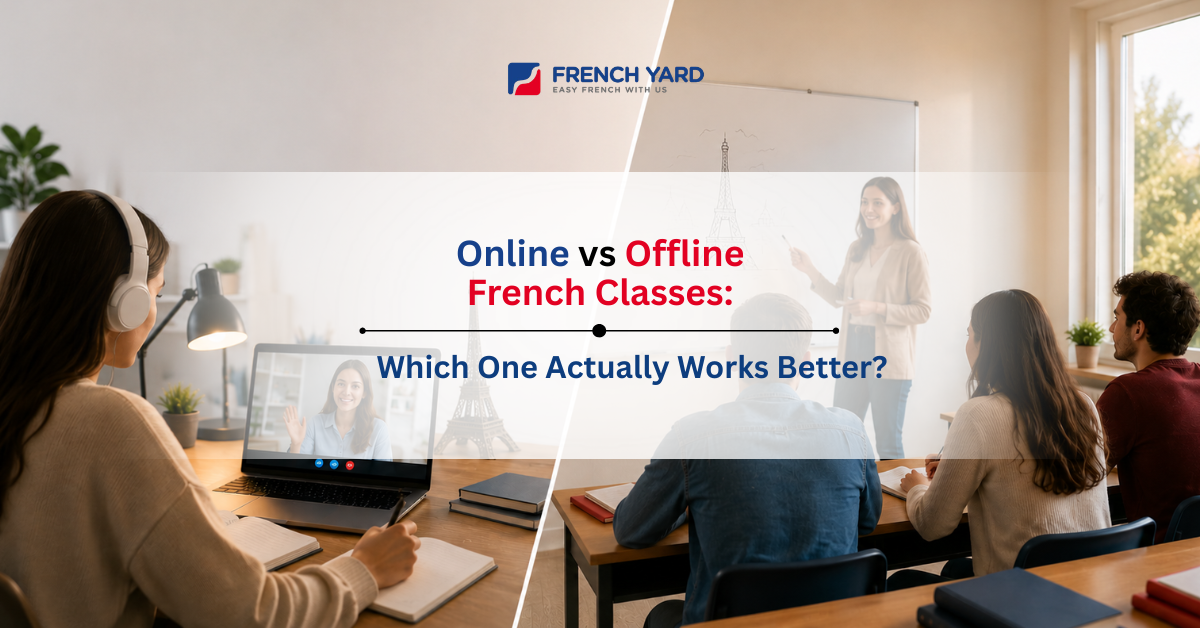
Everyone Has an Opinion on This — But Very Few Have Tried Both
Five individuals questioned regarding whether online or offline classes for French are better will give you five different answers. Ask the individual travelling 45 minutes each way to reach their coaching centre in Bangalore, and they’ll give you their reasons why online learning is the future. Ask someone who tried a self-paced app and gave up in a month, and they’ll insist only in-person classes build real discipline.
The reality of the matter, however, is that it goes deeper and depends on a number of issues that most individuals fail to consider before enrolling in classes. Here’s a guide for you to make an informed decision.
What Offline French Classes Offer
Traditional classroom learning has clear strengths. Physical presence creates a natural sense of routine and accountability — you’ve travelled to get there, so you stay engaged. There is a natural flow of peer interaction, and some students may feel faster progress in their speaking skills due to peer interaction.
But for the majority of people who are working professionals or students in Bangalore, taking French classes offline in Bangalore has some practical challenges:
- Fixed batch timings that rarely accommodate office hours or unpredictable schedules
- Commute time that adds 30–90 minutes to every class day
- Limited access to recorded sessions if you miss a class
- Larger batch sizes where individual speaking time is often minimal
For learners targeting specific exam outcomes — DELF certifications or TEF/TCF Canada for immigration — offline classes don’t always provide the focused, structured preparation that exam success requires.
What Online French Classes Offer
Online French classes in Bangalore are quite different from what one may imagine about e-learning in general. The most advanced programs offered by online courses today revolve around active live classes, which involve not only a teacher but also communication.
The practical advantages for Bangalore learners are significant:
- Flexibility — attend from home, fit sessions around work hours and personal commitments
- Consistency — recorded sessions mean a missed class doesn’t mean missed content
- Focused speaking time — smaller batch sizes give each learner more time to speak, be corrected, and practise
- Exam-specific structure — online programmes can be built precisely around DELF or TEF/TCF Canada preparation timelines
The concern most people raise about online learning is discipline — and it’s a fair one. But this is less about the format and more about the quality of instruction. A live online class with an engaged, qualified teacher maintains accountability as effectively as a physical classroom. A pre-recorded video course does not.
The Real Deciding Factor: Live Instruction vs Self-Paced
The most important distinction isn’t online vs offline — it’s live instruction vs self-paced learning. Learners who progress fastest, regardless of format, are the ones who attend live classes regularly, get real-time feedback on their speaking, and have a qualified instructor correcting their errors as they happen.
This is why French online classes at Frenchyard are built entirely around live sessions — not recorded lectures students watch at their own pace. Every class involves real-time conversation practice, pronunciation correction, and structured grammar instruction delivered by certified French trainers.
FAQs
Q: Are online French classes as effective as offline ones for exam preparation?
Yes — when classes are live and instructor-led, online learning matches offline results. Frenchyard’s French online classes in Bangalore are built entirely around live sessions with certified teachers, not pre-recorded content.
Q: What levels does Frenchyard’s French course in Bangalore cover?
DELF A1 through B2, plus a dedicated 10–11 month TEF and TCF Canada preparation programme for immigration candidates.
Q: Can I attend classes while working full-time in Bangalore?
Yes — Frenchyard offers evening and weekend batches specifically designed for working professionals, with recorded sessions available if you miss a class.
Q: How quickly can I expect to start speaking French?
Most learners begin forming basic conversations within 2–3 months of consistent attendance, with fluency building progressively through higher levels.
Conclusion
The online vs offline discussion doesn’t address the main point – whether the instruction is live, structured, and examination-oriented? For the vast majority of students in Bangalore who must balance their work, travel, and social lives, excellent live French classes in Bangalore, offered through the Internet, have all the advantages of classroom teaching without the limitations.
Frenchyard‘s French learning classes in Bangalore are built exactly for this: live instruction, real speaking practice, flexible timing, and a clear pathway from beginner to exam-ready.
